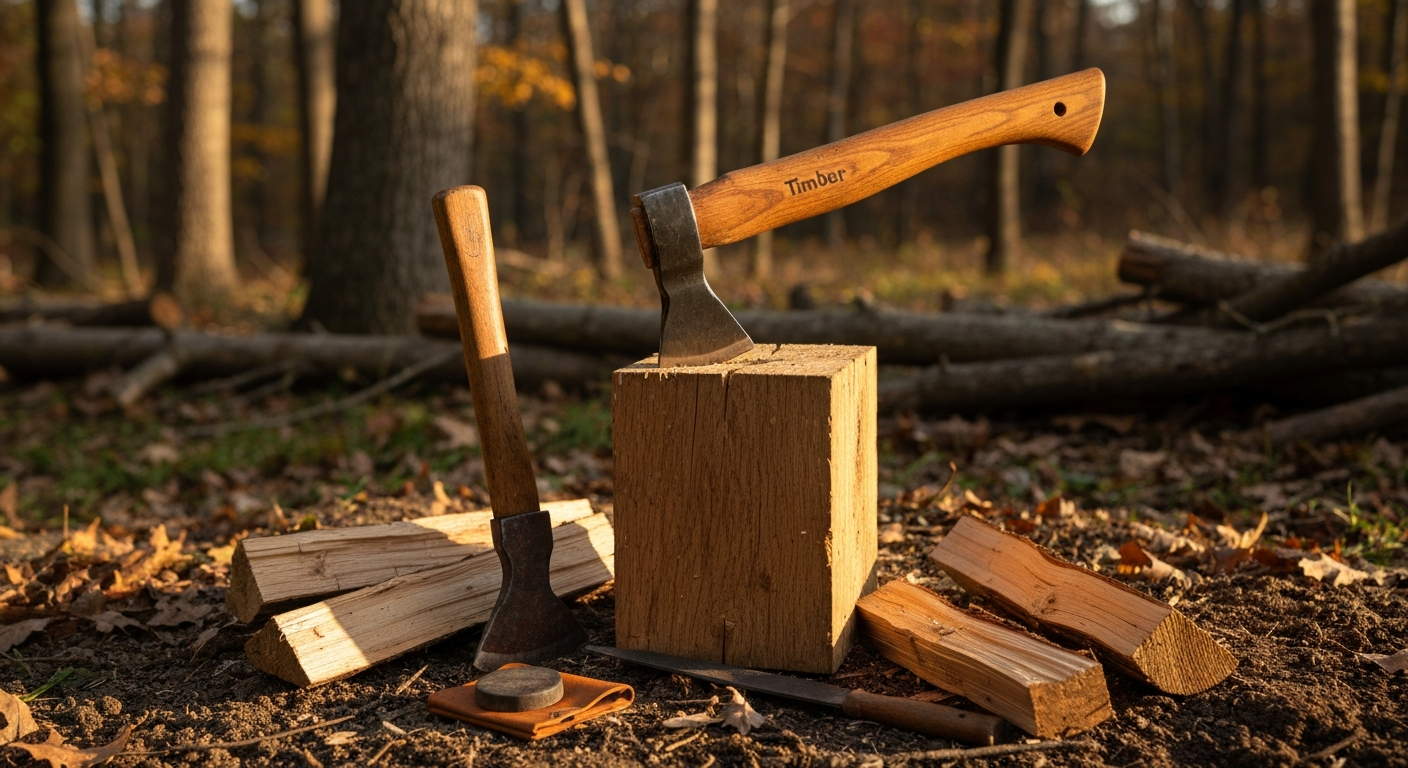
Tested from the woodpile to the whitetail camp.
Honest reviews of hunting axes, hatchets, tomahawks, and bushcraft axes. Written by woodsmen who have hung a hickory handle, sharpened a rusted Kelly head, and quartered elk with steel we picked ourselves.
Hands-on tested · Named writers · No paid picks · FTC compliant
A factory hatchet edge is rarely the edge you want. Twenty minutes at the vise with a fine bastard file, a puck stone, and a scrap-leather strop turns a Council Tool Woodcraft into the tool the marketing said it was. Five numbered steps. One mistake we made on a Velvicut Boys Axe that cost us a re-grind. Bring the vise; do not free-hand a full-size head.
1. Clamp the head, cheek up
Vise the head with the cheek horizontal and the bit facing you. Pad the vise jaws with scrap leather or hardwood; do not clamp bare metal to metal (marks the finish, telegraphs shock into the eye). If you do not have a vise, build a cradle from two scrap 2x4s screwed to a plywood base with a V-notch. Do not free-hand a full-size axe head; it is how you lose the edge geometry and a fingernail.
2. File the primary bevel with a fine bastard
8 in fine bastard file, one direction only (file cuts on the push stroke). Match the existing primary bevel angle; for a bushcraft or hunt-camp hatchet, that is 18 to 22 degrees inclusive. For a splitter, closer to 25 to 30. Six to ten strokes each side; feel for a burr along the full length of the bit. A farrier rasp is too coarse; a mill file is too fine. Bastard-cut is the middle path.
3. Refine with the puck stone coarse side
Coarse side (220 grit) of a combination puck, circular motion, both sides, water lubricant. Chase the file marks out. This is where most guides stop; the edge cuts wood at this point but tears rather than slices. Keep going. Two minutes per side takes the file scratches to a matte grey without polishing them out.
4. Polish with the puck fine side, then strop
Fine side (600 to 800 grit) same motion, less pressure. Then strop on veg-tan leather glued to a block, edge-trailing (pull the edge away from you). Green compound optional; on a working hatchet it is worth 20 percent more slice, on a hunt-camp axe you dress every season it is not worth the tin. Test: the edge should shave a curl off a pencil round.
5. Oil the bit and stow
Wipe the bit with a rag, then a thin coat of camelia oil or 3-in-1 (any light machine oil). Do not use vegetable or olive oil; they go rancid inside a season. Sheath the head and hang the axe head-down. What we would fix: our writer ground a Velvicut Boys Axe with a coarse rasp on the first pass and had to re-grind a full 1 mm off the primary bevel to true it. Fine bastard file first; save the rasp for a broken poll.